Ecosystem Types
Locate the problem in its setting: geography, industries, institutions, and communities. Several Types can apply at once, revealing the assets, relationships, and constraints a useful intervention needs to account for.
 Join the Waiting List
The cards in action
The cards make the human side of ecosystem building tangible—so you can explore a situation together and decide what to try.
Follow a simple referral example through five steps: Structure, Signal, Source, Shift, and Study. Each step has a clear purpose and a small selection of cards.
Start anywhere. Choose the cards that serve your goal. Return as the situation changes.


An illustrative scenario · not a real case study
Local entrepreneurs keep getting passed between support organizations. They repeat their stories and receive lists of websites, but often leave without a clear next step.
The providers call themselves partners. Each is also under pressure to show its own results, and nobody has agreed who follows up on a referral.
Help entrepreneurs reach useful support, with someone responsible for the handoff.
Understand the people involved.
Use three Role cards to explore how the same referral problem looks from different positions.

“I need useful help without losing more time away from my business.”

“If I refer someone elsewhere, who follows up—and will our contribution count?”

“How can we help the providers agree on a handoff they can both carry?”
Three perspectives on the same problem. Check these assumptions with the people involved.
Roles are one part of Structure. Types, Forces, Choices, and Phases add context and depth. Explore the Other Families
Notice what is happening.
Name the observable pattern before considering why it happens.
Signal Observations
Papered Partnership names the gap between a public partnership and shared responsibility in practice. The group checks recent referrals: providers attend partnership meetings, but no one owns the handoff.
A pattern to investigate: partnership is visible, but follow-through is missing.
Ask what may be contributing.
Explore a possible explanation and check it against people’s experience.
Source Tendencies
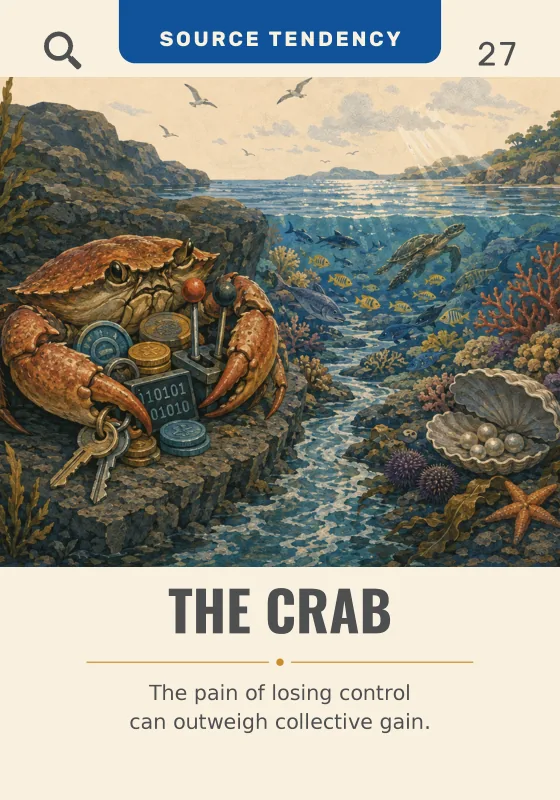
The Crab introduces loss aversion: the prospect of losing something can weigh heavily in a decision. Could fear of losing credit help explain why a provider holds back from a referral?
Ask the providers and check their accounts against recent handoffs. Keep this explanation open to revision.
A working hypothesis to check: a referral may feel like losing credit.
Try a manageable change.
Use a Shift card to guide the development of a specific test.
Shift Tools
The back of The Tandem Bike says:
Shared accountability prevents both blame shifting and vague collective ownership by making contributions, dependencies, and review visible.
The card provides direction and context for developing a specific test. The group uses that direction to design a change that fits the referral problem.
Two willing providers could design a 60-day referral test, with entrepreneurs helping define a useful connection:
A test designed by the group, guided by shared accountability, with named responsibilities and a review date.

Learn from the test.
Use a Metric to agree what to watch, check what happened, and decide what to keep or change.
Ecosystem Metrics
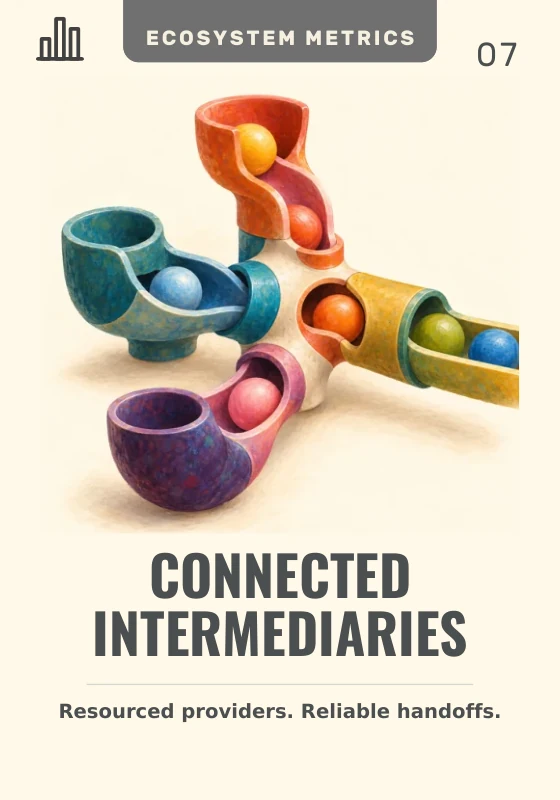
Before starting, use Coordinated and Resourced Intermediaries to agree what to watch: did each referral lead to help the entrepreneur found useful within 30 days?
Keep a simple referral record, including unresolved handoffs. Ask the providers whether they had enough time to follow through. At the 60-day review, decide what to keep or change, allowing the final referrals their full 30-day follow-up.
A decision informed by entrepreneur feedback and the providers’ experience. The findings describe this small test.
The next beginning
The group has followed one question from understanding the situation to trying a change and checking what happened.
What they learn guides the next conversation. They can return to a card, revise an explanation, or adapt the test.
Beyond this example
This example keeps Structure focused on Roles. Four other card families expand the inquiry, helping you understand the context around people and their choices. Bring in the families that help answer your question.
Locate the problem in its setting: geography, industries, institutions, and communities. Several Types can apply at once, revealing the assets, relationships, and constraints a useful intervention needs to account for.
Examine how power, policy, infrastructure, major events, and economic or technological change affect the situation. Distinguish what you can change, influence, or prepare for.
Explore Opportunity, Psychology, Capability, and System: which options people can use, how they interpret a situation, what they need to act, and the conditions surrounding their decisions.
Use Forming, Storming, Norming, and Transforming to consider how shared work is developing. Identify whether a group needs stronger relationships, space to work through differences, shared routines, or a change in approach.
Together, Roles, Types, Forces, Choices, and Phases make up Structure. That fuller picture helps you interpret a Signal, investigate a possible Source, choose a Shift that fits the situation, and Study what follows.
A flexible practice
This example uses three Roles, one Signal, one Source, one Shift, and one Metric. For your own question, choose the cards that help you make progress.
Explore one shared challenge with stakeholders. Select a small set of Roles, Signals, Sources, and Shifts to move from different perspectives to a practical test.
Start with one Signal and one possible Source. Compare experiences, question assumptions, and identify what you need to learn before taking action.
Give tables different card subsets around a common question. Bring back patterns and proposed Shifts for a gallery walk, shared discussion, or collective prioritization.
Use a Role card to examine a decision, then choose a Shift to test. Return to the same cards at a later meeting to review what happened.
Reflect on your own role, assumptions, and relationships. Keep a card beside a current challenge and use its questions to prepare for your next conversation.
Return to a Metric to review whether the shared work is helping entrepreneurs. Use what you learn to adapt the next test.
With advanced facilitation, you might consider several cards from the same family at one stage, comparing possible explanations or interventions. Add cards when they help the inquiry. Each pack or bundle will include a guide with activities using only its included cards.
Coming soon
Choose a Family Pack or Family Bundle with activities designed for the cards included. Training brings the complete collection together.
One card family or a selected group of families for your purpose. Each pack or bundle will be offered at a set price with its own activity guide.
Activities using only the cards included, with setup instructions, facilitation prompts, and debrief questions to support reflection and practical next steps.
Available only through training, with an activities handbook and full digital Card Atlas access for extended explanations, connected cards, and ongoing practice.